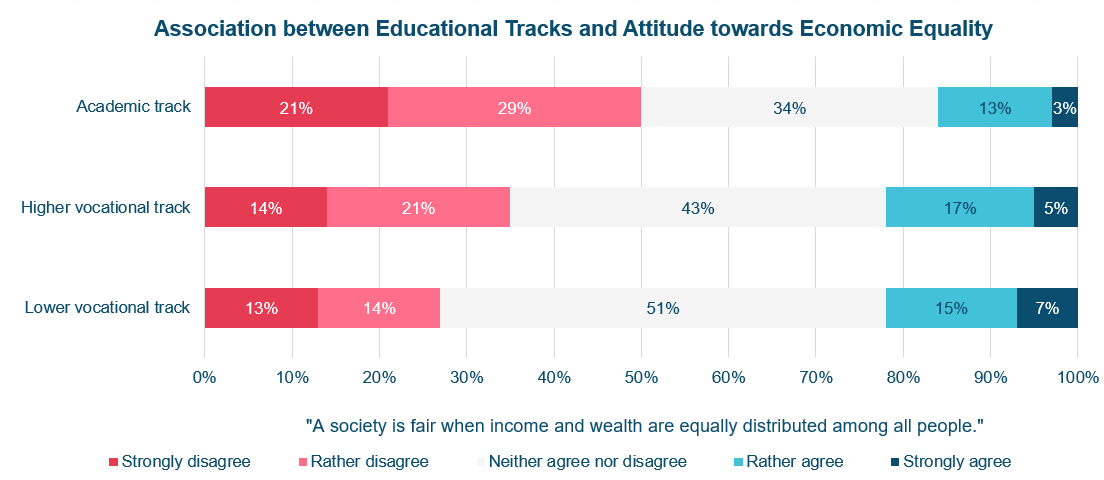
As part of the CZEPS survey, we explore the attitudes of students towards the principles of distributive justice. Distributive justice concerns the just allocation of resources (wealth and income) in society. One of the principles, on which wealth and income can be distributed in society, is equality. Attitudes towards the principle of equality are examined through the degree of agreement with the statement “A society is just if wealth and income are equally distributed among all people.” The following graph shows the relation between the category of education and attitudes toward economic equality in the first wave of our survey. The responses of 22,790 students generally indicate that attitudes towards economic equality are rather negative. Negative attitudes were most pronounced in gymnasiums, where up to half of the respondents expressed disagreement with this statement (responses of “strongly disagree” or “disagree”). Equality, on the other hand, has the highest support among students at vocational schools, where approximately 22 % of them agreed with the statement (answers “strongly agree” or “agree”). Approximately half of students at vocational schools without graduation certificates do not take any position (answer “neither agree nor disagree”). At gymnasiums, only one-third of respondents (34 %) expressed no opinion. In the next waves of the CZEPS survey, we will examine whether the share of students who hold an opinion on economic equality (and other principles of distributive justice) is increasing. The period of adolescence represents a phase of human life when attitudes are gradually formed, even towards such complex issues as the principles of distributive justice.