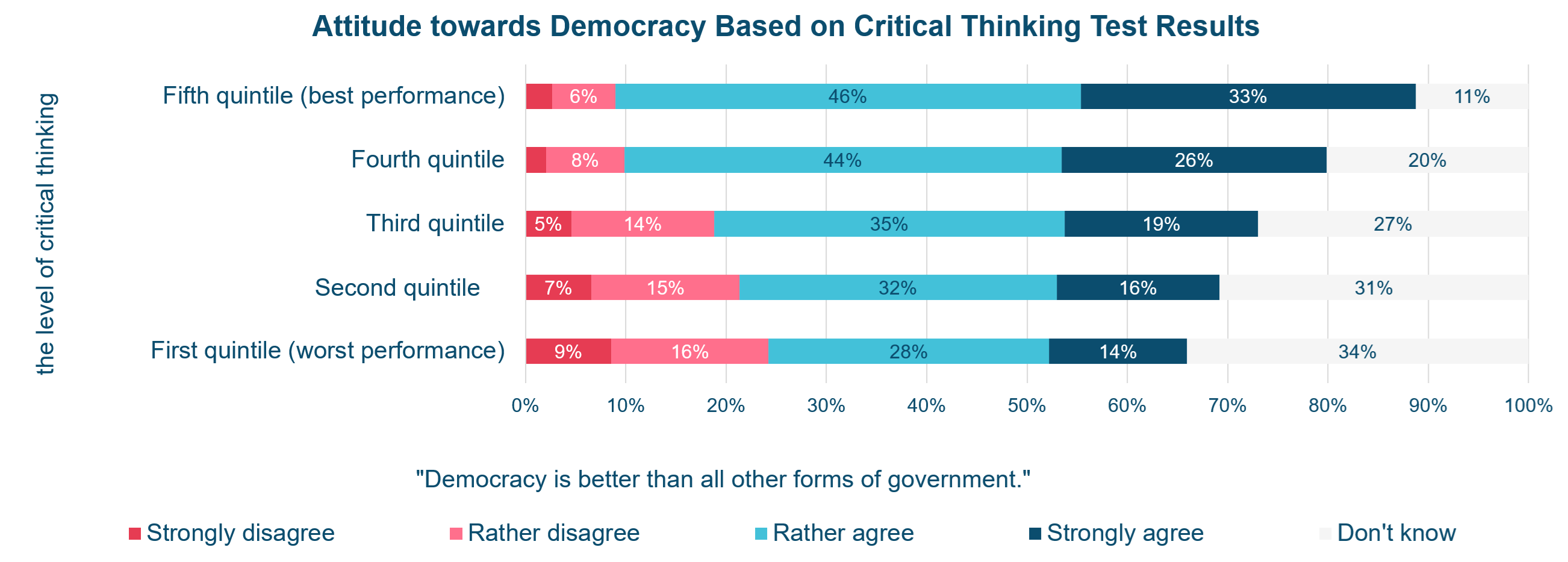
The next phenomenon explored in our research is the relation between critical thinking and attitudes towards democracy. The results are again from the first wave of the CZEPS and include results and responses from 21,170 adolescents. The graph below shows how different groups of students differ in their views on democracy, divided into five groups according to their critical thinking test scores. More than three-quarters (79 %) of adolescents who scored highest on the critical thinking test “strongly” or “rather agree” that “democracy is better than all other forms of government.” On the contrary, students with lower levels of critical thinking have a higher tendency to disagree with this statement. For students with the weakest performance on the critical thinking test (first quintile), only 42 % of respondents “strongly” and “rather agree” with this statement. Moreover, there is a clear relation between critical thinking and the proportion of “I don't know” responses. While among adolescents with the highest test scores, 11 % of respondents used the "I don't know" response, more than one-third (34 %) of those with the lowest levels of critical thinking did not express an opinion about democracy. The results show that adolescents with higher levels of critical thinking are more likely to form an opinion about the government system and have a more positive attitude towards the democratic establishment than those with lower levels of critical thinking. These results support the importance of developing critical thinking skills to promote democracy.