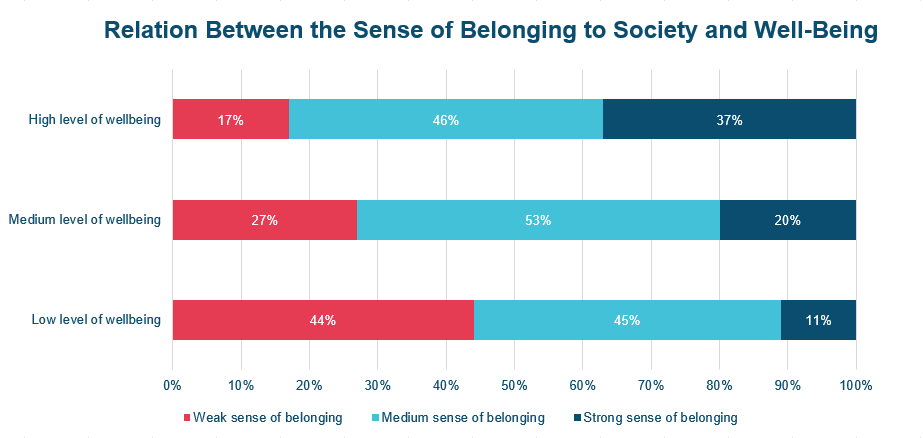
In the first wave of CZEPS data collection, we also asked the respondents about their sense of belonging to society. This concept measures the extent to which the respondents feel accepted and respected by the society they live in. We investigated whether the sense of belonging to society is related to well-being. To make the interpretation easier, the values of a sense of belonging were transformed into 3 categories: weak, medium, and strong. The same method was applied to well-being (low, medium, and strong level). The results, containing responses from 22,564 students, show that higher levels of well-being are associated with a stronger sense of belonging. The graph shows that only 17 % of adolescents with high levels of well-being have a weak sense of belonging. In contrast, 44 % of pupils with low levels of well-being feel a weak sense of belonging. A strong sense of belonging was expressed by 11 % of adolescents with low levels of well-being but as much as 37 % of adolescents with high levels of well-being. The results suggest that for students’ overall mental health and peace of mind, it is necessary for them to feel like fully-fledged members of society.