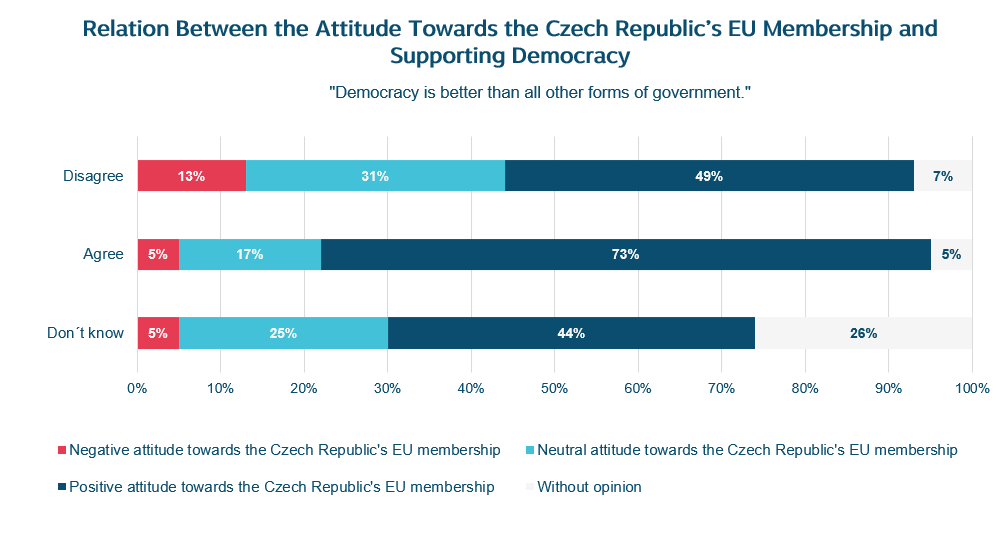
As a result of its complex decision-making methods and processes, the European Union is often criticized for its so-called democratic deficit. Populist criticism of the EU also often refers to the “dictatorship of Brussels” and the “loss of sovereignty”. These statements reflect, among other things, the EU's remoteness and lack of clarity for the average citizen. A possible consequence is that supporters of democratic governance are also critics of the EU. This is even though support for democratic principles of governance is one of the EU's core values. Therefore, we looked in our survey at adolescents’ views on the Czech Republic’s EU membership and the relation between support for democratic governance and attitudes towards the Czech Republic’s EU membership. Among 22,877 respondents, a positive attitude towards the Czech Republic's EU membership is significantly prevalent (62 % consider membership to be “definitely” or “rather” a good thing), 21 % have a neutral attitude and only 6 % of adolescents have a negative attitude. One-tenth of respondents have no opinion on the Czech Republic’s EU membership. If we compare the attitude towards the Czech Republic’s EU membership with the attitude towards democracy, we can see that almost three-quarters (73 %) of adolescents who agree with the statement that “Democratic governance is the best possible way” also have a positive attitude towards the EU and only 5 % of them have a negative attitude towards the EU. Our results suggest that the premise of the democratic deficit of the EU is not reflected in the respondents’ attitudes towards the Czech EU membership. On the contrary, the Czech EU membership is mostly supported by those who see democracy as the best possible way of governance.