Empathy is the reaction to the emotional experiences of another person. It is a complex skill that has two main dimensions: an emotional response (feeling concern or sympathy for the other person) and a cognitive response (imagining how the other person feels). Research has shown that both types of responses play an important role in the social development and behavior of youth. Students with higher levels of empathy tend to be more skilled socially and engage in more prosocial behaviors (for example, helping others). Research has also shown that people with higher levels of empathy are less prejudiced and more positive toward groups different from their own (for example, immigrant groups).
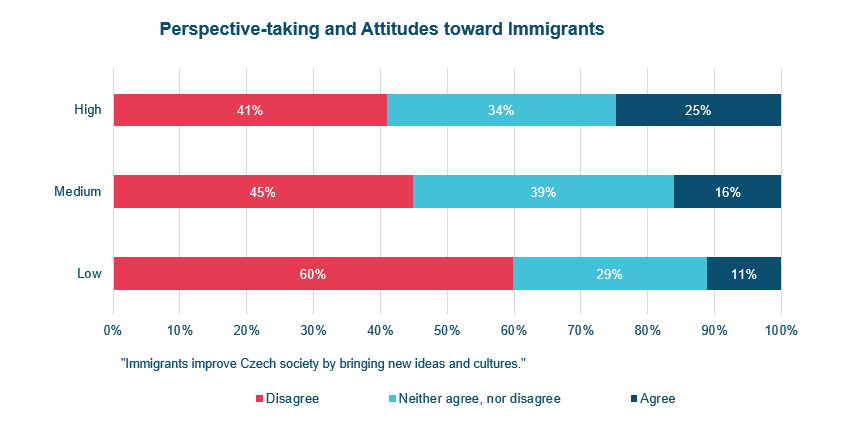
In our data collection, we asked students to fill in a short scale measuring both dimensions of empathy. We also asked them to indicate their agreement or disagreement with statements related to immigration. Overall, higher scores on both dimensions of empathy were related to more positive attitudes toward immigrants. In this analysis, we will show one example from the second wave of data collection, the relationship between perspective-taking (the cognitive dimension of empathy) and the belief that immigrants bring new ideas to Czech society. Among those who had a low score on perspective-taking 11% agreed and 60% disagreed with this statement (29% neither agreed nor disagreed), while among those who reached a high score on perspective-taking 25% agreed and 41% disagreed (34% neither agreed nor disagreed). Among those respondents who had a medium level of perspective-taking, 16% agreed and 45% disagreed (39% neither agreed nor disagreed).
We can see that a large proportion of respondents disagreed with the statement at all levels of perspective-taking. However, the proportion of disagreement decreased, and the proportion of agreement increased, at higher levels of perspective-taking. These results show that the ability to “put oneself in someone else’s shoes”, that is, imagining how others feel or think, can help respondents recognize the contribution of groups different from one’s own to society.