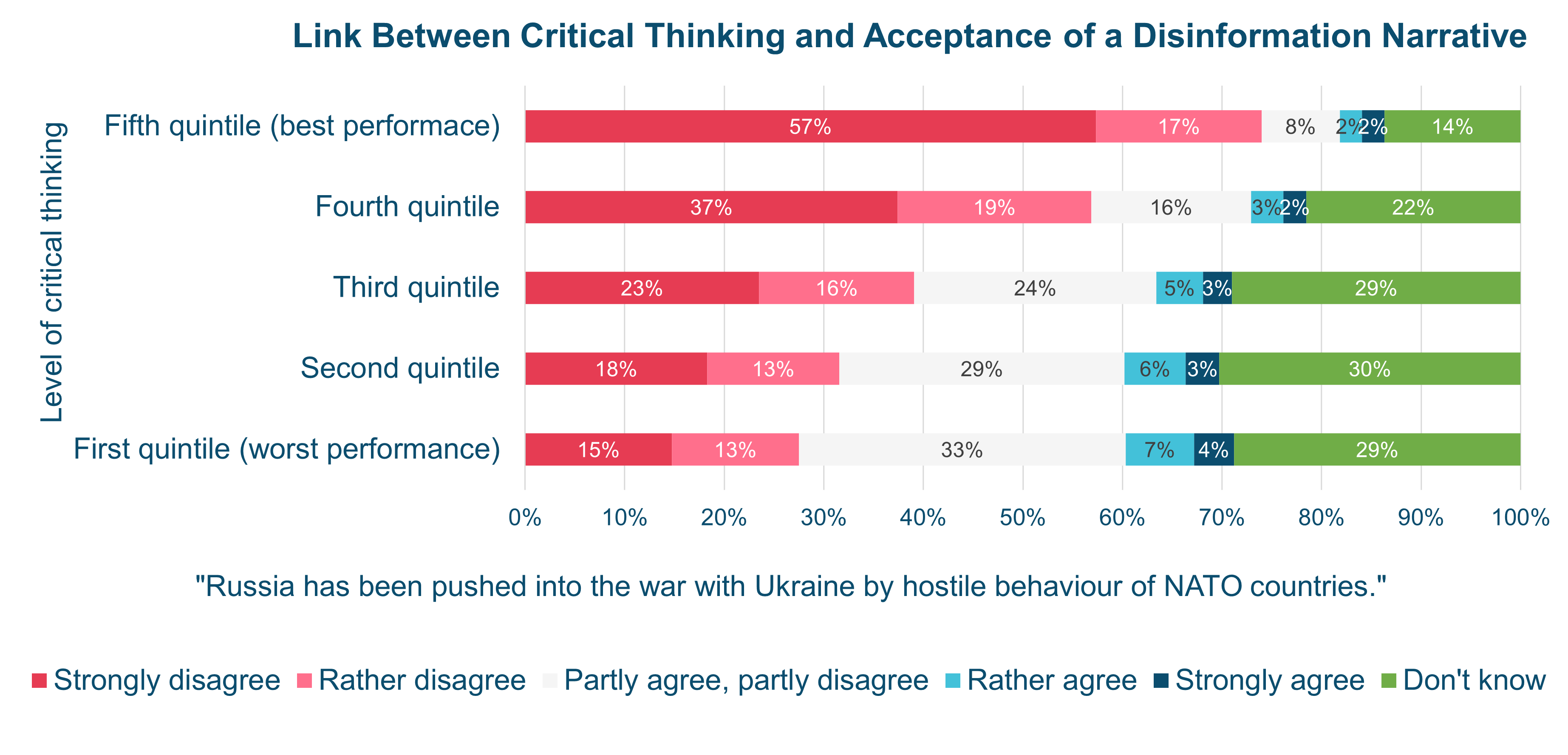
Data from the first and second waves of the CZEPS survey show an association between the level of critical thinking and agreement with disinformation. The indicator of critical thinking comes from the first wave, while the statement reflecting a widely spread disinformation narrative was included in the second wave. The figure below presents responses from 16,400 students who participated in both waves of the study. Among students with the lowest performance in the critical thinking test (first quintile), 11% agreed (“rather agree” or “strongly agree”) with the disinformation statement. In contrast, only 4% of those with the highest critical thinking scores (fifth quintile) expressed such agreement. On the other hand, 74% of students in the highest quintile “rather” or “strongly” disagreed with the disinformation narrative, compared to just 28% of those in the lowest quintile. The difference in the share of respondents choosing “don’t know” or “partly agree, partly disagree” options is also important. While 29% of students in the lowest quintile were unable to express a clear opinion on the statement, only 14% of students with the highest critical thinking level chose this option. Furthermore, 8% of students with the highest level of critical thinking and 33% of those with the lowest results in the critical thinking test say the statement is “partly agree, partly disagree.” These findings suggest that the ability to think critically is not only associated with lower acceptance of disinformation but also with greater decisiveness and a higher capacity to form independent opinions. The results underscore the importance of developing critical thinking skills as a safeguard against disinformation narratives.