Social norms—shared expectations about appropriate behavior—play a crucial role in shaping individuals' values, attitudes, and behavior. One of the core democratic values is the principle of equality regardless of race, ethnicity, or religious background. In this study, we explored to what extent students perceive that their classmates support this value, and how this perception relates to their own attitudes toward immigrants.
As part of the second wave of the CZEPS study, conducted in autumn 2024 with a sample of 20,057 respondents, we asked students whether their classmates express views supporting equality and fair treatment of people from different cultural backgrounds. The results show that 70% of respondents do not encounter such views among their peers.
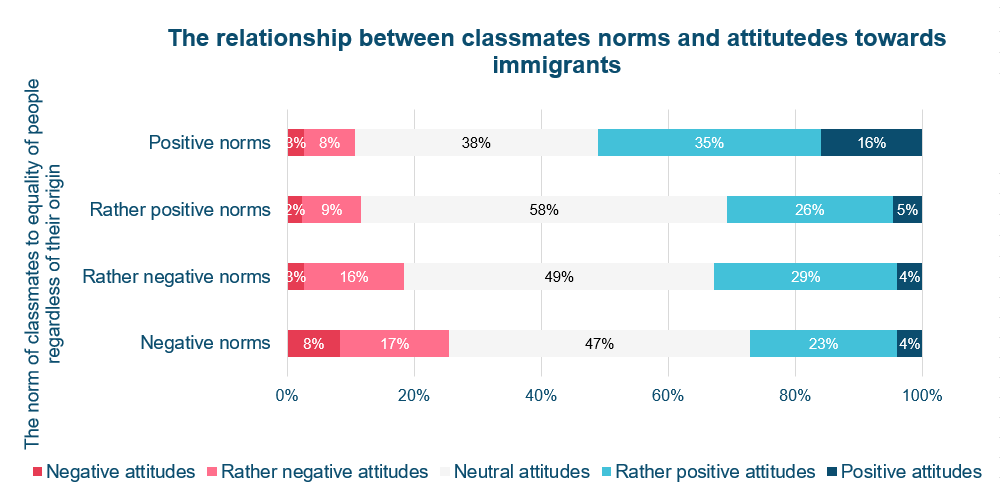
We also examined the relationship between the perceived classroom norm and individual attitudes toward immigrants. These attitudes were measured using a scale of three statements, with students indicating their level of agreement. The findings reveal that the most common stance among adolescents is neutral (49%), while 31% express positive attitudes.
The analysis revealed a significant link between the perceived classroom norm and students’ attitudes: the more students perceive that their class supports the value of equality regardless of background, the more likely they are to hold positive attitudes toward immigrants. Specifically, in classrooms where the norm of equality is perceived as positive, the share of adolescents with rather positive or positive attitudes toward immigrants is 24 percentage points higher than in classrooms where this norm is seen as negative.
These findings underscore the important role of school environments and peer norms in shaping attitudes toward diversity and suggest that such norms can contribute to strengthening democratic values among young people.