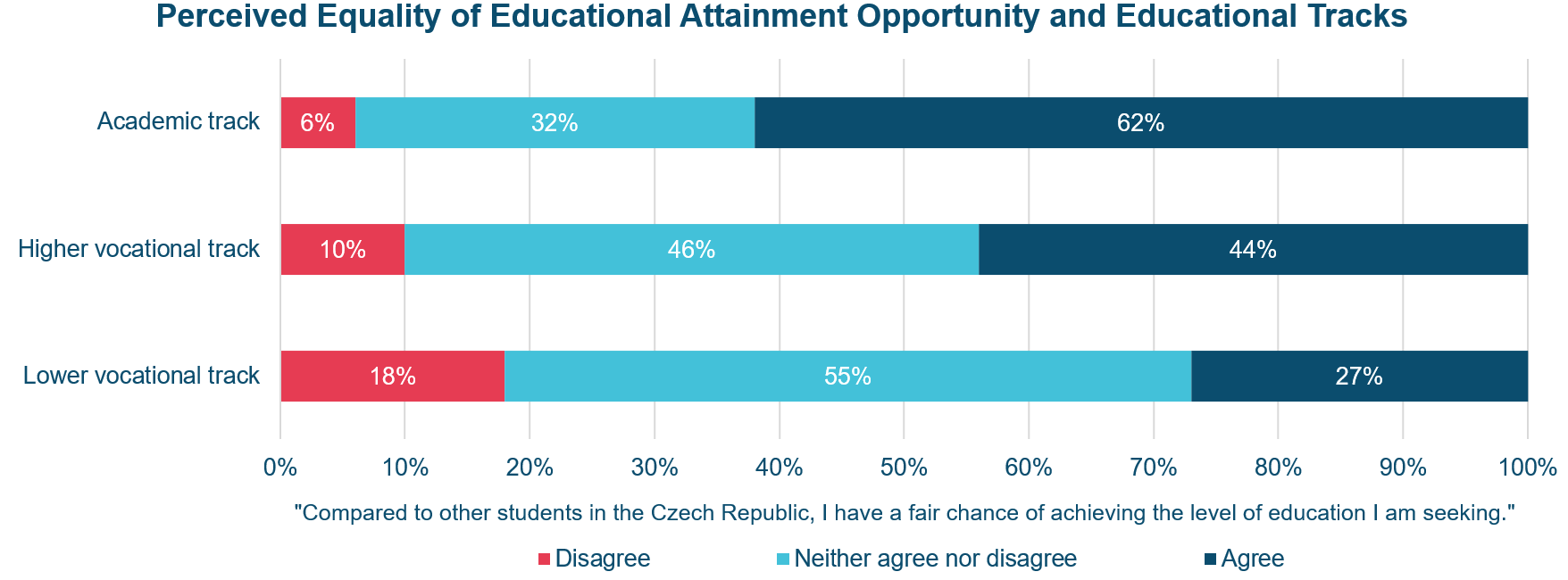
Perceived equality of educational attainment opportunity refers to an individual’s subjective belief that they have a fair and non-discriminatory chance to achieve the desired level of education regardless of their background or personal characteristics (e.g., socio-economic status, gender, place of residence, ethnicity, etc.). This concept generally captures an individual assessment of the fairness and accessibility of educational opportunities compared to others in society. As part of the second wave of the CZEPS survey in autumn 2024, we measured the perceived equality of educational attainment opportunity through agreement with the following statement: “Compared to other students in the Czech Republic, I have a fair chance of achieving the level of education I am seeking.”
The results of the second wave of the CZEPS survey show that the subjective feeling of having a fair chance to achieve the desired education varies significantly among students in different educational tracks. Agreement with the statement was expressed by 62% of students in the academic track, compared to 44% in the higher vocational track and only 27% in the lower vocational track. Conversely, disagreement with the statement was more common among students in the lower vocational track (18%) than among those in the academic track (6%). Moreover, students in the lower vocational track chose the middle response category for assessing subjective equality of educational attainment opportunity much more often than those in the academic track. This may indicate a lower degree of decisiveness in their attitudes in this area. The differences presented in the figure suggest that the educational track may influence the perception of equality of educational attainment opportunity. More detailed follow-up analyses may reveal structural or institutional factors that shape the subjective perception of this fairness, thereby contributing to a better understanding of educational inequalities