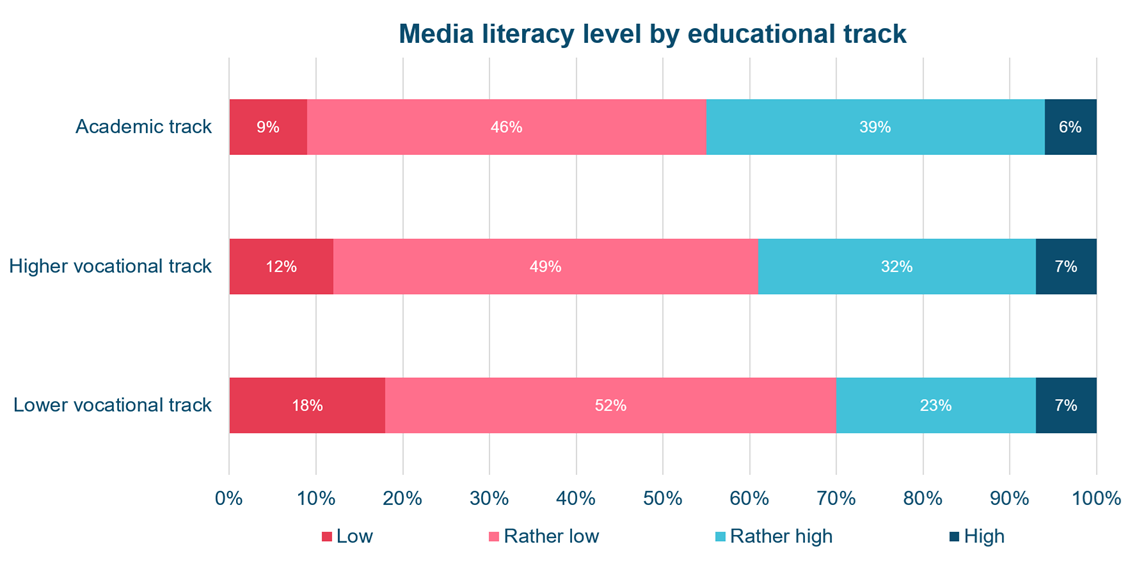
Media literacy is an important competency for navigating today’s information environment. It includes, among other things, the ability to critically assess information, distinguish reliable sources, and understand how media influence our opinions and behaviour. We therefore included a nine-item battery in the third wave of the CZEPS survey in order to explore this topic in greater detail. We were interested in whether students’ level of media literacy differs according to the educational track they attend. For ease of interpretation, the overall media literacy score, ranging from 9 to 45, was divided into four categories: low (9–18), rather low (19–27), rather high (28–36), and high (37–45) levels of media literacy.
The results, based on responses from 18,237 third-year students, showed that there is an association between these two variables. The highest proportion of students with a “high” or “rather high” level of media literacy was found among students in the academic track, where they accounted for 45%. Among students in the higher vocational track ending with the maturita exam, this proportion was 39%, compared with 30% among students in non-maturita programmes (lower vocational track).
Conversely, a “low” level of media literacy was reported by 18% of students in the lower vocational track, 12% of students in the higher vocational track, and only 9% of students in the academic track. Overall, the most common category across all three types of educational tracks was a “rather low” level of media literacy, reported by approximately half of respondents in each group. The findings therefore point to an association between type of educational track and level of media literacy. However, the results alone do not explain why these differences occur. Factors such as different educational experiences, family background, or interest in public affairs may play a role; identifying these mechanisms will be the subject of further analyses.